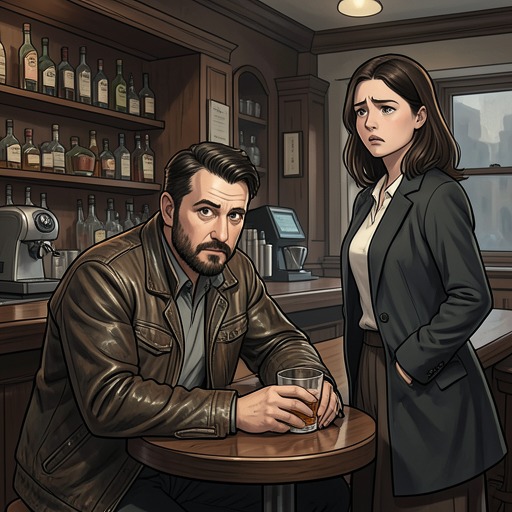
Roy’s relapse and delirious flight through town
The Master Butchers Singing ClubRoy’s relapse and delirious flight through town mark the point at which his return to drinking can no longer be hidden behind brief stretches of apparent sobriety. His familiar explanation—that alcohol fills an inner emptiness—becomes both a private justification and a refrain among his companions; the relapse exposes its limits when Delphine finds him in a public crisis and must take charge of his immediate care.
Background: Emptiness and the Return to Drinking
Roy often explained his drinking by saying, “I drink to fill the emptiness.” Delphine disliked the line and once answered that everyone was trying to fill emptiness in one way or another. Roy took comfort in the thought that his loss and loneliness were not uniquely his own. During the long period of sobriety after Eva’s death, he treated Delphine’s remark as a serious instruction: he tried to fill the void through other activities, but, in his view, nothing worked as well as alcohol.
The relapse gathers force in a conversation with the men of the singing club. Sitting among them in a partly ruined arbor while Fidelis is away, Roy speaks at length about the abyss, love, alcohol, and religious belief. He says that he no longer has Minnie’s love, cannot believe in the Lutheran or Catholic God, and lacks the imagination to invent a faith of his own. He then recasts the human body as a vessel left empty by God and spirits as the drink meant to fill it. The others nod rather than encourage him to continue. The scene makes his return to drinking foreseeable: his talk is not a new discovery so much as the old argument that prepares the way for the old habit.
His drinking resumes gradually, beginning with small amounts of beer and growing into a sustained return to alcohol. Roy lies to Delphine, claiming that he is working with Step-and-a-Half while drinking instead at the bum’s jungle, on the pool hall’s back steps, or elsewhere that will admit him. Because he is no longer allowed inside the pool hall, even the places where he drinks register his increasing estrangement from ordinary social life.
Concealment and Discovery
Roy stays away from home, partly to keep Delphine from discovering the relapse and partly to avoid the dead Chavers family, whose spirits leave him alone when he keeps away from the place where their deaths occurred. He is not continuously drunk: two or three days each week, he manages to sober up and stay with Delphine. During those visits he becomes unusually solicitous, cooking substantial breakfasts, washing his own clothes, and scrubbing floors. Delphine has never known this pattern in him, and its contrast with his absences helps keep her from understanding what is happening.
The disguise fails when Delphine returns from Chicago and begins looking for work. At Step-and-a-Half’s shop, she hopes to obtain Tante’s former position. Step-and-a-Half tells her that she does not need the work so much as she needs to leave Roy, and says she had thrown him out of the shop the previous day because he was drunk. Delphine angrily rejects the warning, insisting that Roy has changed and that his pledge has held. Yet she recognizes the truth in what she has been told. She leaves without further argument, and the relapse weighs on her as she returns home.
Her reaction is divided between concern and resentment. She tells herself she will not go looking for Roy and will check on Markus instead. She cooks dumpling soup for Markus, who had lived on it after his near burial, and drives to Waldvogel’s. The trip also makes her financial insecurity immediate: she has only ten dollars left and no reason to expect a contribution from Roy. She decides that she will sell her car if she cannot find work before the end-of-month bills are due. Roy’s relapse therefore changes more than her understanding of his condition; it removes a possible source of support and sharpens the pressure on her already precarious search for employment.
Delirium and the Chase Through Town
On a March morning, Delphine encounters Roy in a severely confused state. Naked and disoriented, he moves erratically through the street, and she recognizes him by his hoarse call. When she approaches, he recoils and runs. The narrative follows their pursuit across the town rather than treating the episode as a private emergency: Roy passes the drugstore, the Lutheran church, a yard, the town park, and the area around the fire station, while Delphine tries to keep him from disappearing into further danger.
The chase carries them through ordinary public places and draws the attention of people who do not know what has happened. Roy nearly runs into Mrs. Orlen Sorven, who calls for help; in the park, a woman shields her toddler’s eyes. Delphine calls out that her father is harmless, attempting to reassure those watching even as she struggles to catch him. Her effort is complicated by the heels she is wearing while looking for work. When Roy evades her near the gas pumps, she takes off her shoes and continues in stockinged feet, accepting that her last good pair may be ruined.
Delphine finally tackles Roy as he runs toward the town grade school. A gym teacher comes out, places a towel beneath himself, and helps hold Roy until he can be covered. Teachers and children watch from the windows. Once dressed in Delphine’s coat, Roy is meek and allows her and the gym teacher to lead him home. The contrast between his frantic attempt to flee and his quiet compliance after being caught gives the episode its reversal: the daughter who has just refused to search for him becomes the person who brings him back and manages the emergency.
Care, Medical Judgment, and Consequences
At home, Delphine gives Roy water with sugar and salt, puts him to bed, and pins a sheet around him for safety because he dislikes being confined. She calls Doctor Heech, who agrees to come after completing his appointments. Once Roy is asleep, Delphine goes back to the lumberyard, where she had hoped to find work, only to learn that the job has been filled. The employer also asks that Roy not sleep in the lumber piles again, citing the danger that he might start a fire among the pallets. The crisis has thus followed Delphine into the search for work: caring for Roy and trying to secure her livelihood cannot be neatly separated.
Doctor Heech assesses the damage Roy’s drinking has done to his health and describes his liver as gravely impaired. Roy protests that he tried, but the doctor refuses to offer an easy prediction about whether he will survive. Instead, Heech declares that Roy will live, making that demand sound like an order and tying it to the care he has already invested in Roy and to Roy’s obligation to show consistent goodness to Delphine. He tells Delphine to taper Roy off alcohol and gives her cough syrup. His blunt instructions combine a severe judgment of Roy’s condition with a refusal to treat him as already lost.
The episode leaves Delphine carrying the practical burden of Roy’s care while continuing to face unemployment and financial strain. It also clarifies the pattern behind his relapse: the secrecy, periodic sobriety, domestic helpfulness, and renewed drinking were not evidence that the problem had passed, but parts of the concealment that delayed her discovery. Roy’s flight makes the hidden crisis public; Delphine’s pursuit and care bring him home, but neither the doctor’s command nor her efforts establish that his drinking has been resolved.